CategoriesDesign Technology

How to have your own private gym at home

Speaking of well-being, do you know how important physical activity is for your body?

A well-known Harvard University study (later taken up around the world and now universally accepted) showed that cardiovascular risk decreases as the amount of exercise increases, reaching its lowest point with 6-8 hours of activity a week.

So exercise will not only help you lose those extra kilos and like the way you look more, but above all it will benefit your health.

It is all clear and simple, but how many times have you put off joining a gym because you did not feel like going out after work, perhaps in the cold, to crowded gyms where you have to queue for the equipment?

Or because you do not feel comfortable among bodybuilders who are always competing with one another?

The generous spaces of a villa allow you to have a wellness area which, besides the spa, can also include a private gym, where you will find everything you need to train safely in the sports you prefer, every day at any time you like, in complete peace and without setting foot outside the house.

You will avoid wasting time travelling and enjoy these moments in complete relaxation, with no queues, listening to the music you like. Both body and mood will benefit.

Now you will be wondering:

Between exercise bikes, treadmills, rowing machines and all the other equipment, what should my private gym never be without?

[ Photo 1: Example of a gym fitted out with Technogym equipment ]

Before talking about specific equipment, let us take a step back.

The concept of ‘physical activity’ is often confused with ‘exercise’: the former includes any form of movement, while the latter refers to activity carried out for specific purposes, according to your goal.

Effective exercise is made up of three fundamental types of activity:

  • aerobic
  • strength
  • flexibility

All-round training includes all three of these activities, clearly in different proportions depending on your goals and your age.

Whether you want to lose the extra kilos put on over the holidays, get the famous “six-pack” or simply be fit and feel good, the right thing to do is targeted exercise.

Broadly speaking, the benefits you can gain from aerobic work, combined with a correct diet, are reduced body fat, blood pressure and cholesterol, and increased general endurance and metabolism.

This activity also benefits your state of mind, giving you a “good mood” and better rest in the long term.

So the next day you will go to work more rested and in better shape.

This category of equipment includes treadmills, exercise bikes, steppers, elliptical cross trainers and rowing machines.

[ Photo 2: Technogym machine for aerobic work ]

Strength training, on the other hand, supports the overall functioning of the body and improves your posture. Muscles are very important shock absorbers, able to absorb the stresses on the skeleton, and strengthening them helps you avoid the risk of joint injuries.

For muscle toning, the options range from multi-function machines to the most basic benches for training with dumbbells and barbells.

[ Photo 3: Technogym machine for strength work ]

Finally, flexibility work allows you to carry out all your everyday movements naturally and fluidly, and slows the natural ageing of tendons, bones and muscles.

Flexibility can be achieved through regular stretching exercises.

As well as equipment for “passive” stretching and/or assisted stretching, there are many bodyweight accessories that can help you carry out stretching exercises in complete safety.

[ Photo 4: Technogym accessory for bodyweight exercises ]

So, a complete workout involves the right mix of these three types of activity, and your private gym should have all 3 categories of equipment.

When we design your villa, we define the ideal space for your gym and, with the help of Technogym, choose with you the equipment and machines suited to all your needs.

If you would like to know more about our working method, book a personal video call with no obligation and you can tell me about your specific needs.

If you would like to ask us something straight away, call us or message us on WhatsApp at +39 392 150 0378 and one of our Architects can already give you some initial answers.

CategoriesTechnology

The 5 rules for getting kitchen lighting right

The kitchen is the room where lighting matters more than anywhere else, given the variety of activities that take place there, each of which needs carefully planned light.

The way we live in the kitchen has changed completely, as modern kitchens have increasingly become sociable spaces where you can invite a friend round for a relaxed coffee.

Lighting has kept pace with these needs, and ever more advanced lighting solutions have been developed, almost making you feel as if you were in the dining room or living room.

[ Photo 1: Kitchen setting by Poliform with Taraxacum pendant lighting by Flos ]

So I thought I would give you 5 rules to always bear in mind to light your kitchen as well as possible:

1. Rule number one is to be clear about the design of the room: the placement of the furniture, the size of the room, the windows, and the colours and materials chosen for your kitchen are the starting point for planning the lighting.

2. In the kitchen, excellent visibility is essential for cooking and cleaning properly, so you need to pay particular attention to the worktop, which must be perfectly lit with specific, directed light.

If your worktop runs along a wall, the ideal solution is under-cabinet LED lighting, which lights the whole surface evenly.

If you have an island worktop, the type of lighting changes and adjustable ceiling spotlights can be used.

3. Another important point is to provide general lighting that lights the whole room with diffused light, so you can see all the furniture clearly and move around safely.

So, if you like a minimal style, one solution is to use plasterboard bulkheads that screen the direct light; alternatively, you can install diffused-light spotlights or LED strips.

4. It is absolutely essential to pay attention to the dining table or breakfast bar area. Here, pendant lighting is indispensable.

Light over a table should always come from above and be positioned over the centre of the table, as in the image above. This type of light lets you focus attention on the table, while also giving you a decorative piece that can lend personality to your kitchen.

5. Finally, the last rule is the choice of the colour and colour temperature of the LED.

I recommend using 3000K white for sociable moments or when you want to relax, as it gives a warm, comfortable light that is pleasant to the eye.

While you are preparing food, a cooler light is advisable, as it lets you see objects and the colours of the food you are preparing more clearly.

Varying the colour temperature is only possible with LED lighting combined with home automation.

So is it not enough simply to fit spotlights in the kitchen, as many people do?

As you have seen, every activity you carry out in the kitchen needs a specific type of lighting, planned together with the design of your kitchen, which as well as improving your daily life also has a considerable impact on the look of your home.

The play of light and shadow, and the lamps and pendant lights you choose, give each room a different atmosphere, especially if they are controlled by home automation, like your appliances.

To achieve this, it is important for the Interior Designer to work together with the Architect and the Lighting Designer, as happens in every Wondervilla project.

In the villas we design, the kitchen lighting is decided together with the furniture: the Architect, Interior Designer and Lighting Designer work on the same design, before construction begins.

If you would like to know more about our working method, book a personal video call with no obligation and you can tell me about your specific needs.

If you would like to ask us something straight away, call us or message us on WhatsApp at +39 392 150 0378 and one of our Architects can already give you some initial answers.

CategoriesTechnology Wondervilla advice

How to avoid indoor pollution in your villa

Have you ever woken up in the morning already tired and with a bad headache?

If so, there is one thing you really must consider.

You may not know it, but the air you breathe at home is more polluted than the air outside, and the headaches and tiredness you have felt so many times may have been caused by the stale air you breathed at home during the day and night.

[ Photo 1: The headaches and tiredness you feel can be caused by stale air and by certain pollutants found in your home. ]

In addition to the carbon dioxide you produce by breathing, there are many other pollutants, such as formaldehyde, benzene, radon, PM10 particulate matter, pollen, bacteria and others contained in detergents and cleaning products, the vapours produced by cooking or showering, and certain substances given off by furniture and clothes.

In technical terms, all this is called “indoor pollution”, that is, the pollution we find inside buildings.

This pollution can have immediate consequences for your health and that of your children, in the form of allergies, breathing problems, tiredness, dermatitis, asthma, eye irritation and headaches.

Some of these pollutants are carcinogenic, as the Italian Ministry of Health has stated on several occasions (see: www.iss.it/indo or www.quadernidellasalute.it).

You often notice unhealthy air in the house from the smell of stale air as you step through the front door, or when you see mould in the corners between the walls of some rooms.

[ Photo 2: Indoor pollution can harm your health and that of your children. ]

How many times have we been told “open the window, the air is stale”?

Well, opening the window, as people did years ago, lets the warm air out of the room and clean, cold air in. The reverse happens in summer, when opening it lets hot air in and the cool indoor air out.

This results in a great loss of energy, because not only is the warm air your boiler has already heated lost, but you also have to heat the cold air that has just come in.

If the air were changed as the regulations require (half the volume of the room every hour) by opening the window around the clock, your house would always be cold and your gas bill would always run into three figures.

In reality, in the past windows were not opened so often, because old window frames leaked like sieves and let in draughts from every side, which naturally changed the air inside the rooms, but at a great cost in energy.

That is why high-performance windows with double or triple insulated glazing and airtight seals were invented, with gaskets that prevent draughts.

These windows have greatly reduced heat loss to the outside, but they have also turned rooms into sealed spaces with no change of air.

For this very reason, mould often forms on the cold walls of the dampest rooms (bathroom and kitchen) after the windows have been replaced.

The problem sometimes also occurs in new homes that still have to release all the water used for mixing concrete and laying masonry (drying usually takes up to two years).

[ Photo 3: Diagram of the percentages of heat loss in a home]

So how can you solve the problem of changing the air without wasting energy?

I will not bore you with technicalities: all you need to know is that to purify the air you need a controlled mechanical ventilation system, which automatically replaces the stale air inside the house day and night, even with the windows closed.

This system is designed to extract stale, polluted air and replace it with clean, filtered air drawn from outside.

The system consists of a fan unit and ducts concealed in the walls and ceilings. The fan draws stale air from the most polluted rooms (bathrooms and kitchens) and expels it outside. At the same time it draws in clean air from outside and supplies it to the living spaces (bedrooms and living room).

The speed and frequency of the air change are adjusted automatically according to whether you are in the room and to the level of pollution present.

[ Photo 4: Diagram of the mechanical ventilation system by Airplast]

But if it draws in cold air from outside, won’t heating it use a great deal of energy?

The latest systems, known as MVHR (mechanical ventilation with heat recovery), are designed to recover heat from the outgoing warm air and transfer it to the incoming cold air. This is done by means of a “heat exchanger”.

You know the old radiators with hot water circulating inside, which heat the air passing through them and so the room they are in?

The heat exchanger works like a radiator in your home or in your car, except that only air circulates instead of water.

Through the heat exchanger, the outgoing airflow transfers heat to the incoming airflow, with an energy saving of over 70%.

What are the advantages of installing an MVHR system?

  • With an MVHR system you always have clean air in the rooms you live in. The air is clean not only because it is free of gaseous pollutants but also because it is free of dust, as it is filtered on the way in.
  • Minimal energy loss, maintaining the comfort that would be lost if you had to open the windows to change the air.
  • It prevents mould and condensation that can form in new rooms as a result of normal daily life or as a new house dries out.

What benefits follow from this?

  • In the morning, when you and your children get up, you will no longer feel that nagging headache or tiredness, and you will be more productive at work and at school.
  • Your home will always be clean, and you will not have to keep dusting the furniture.
  • With the heat exchanger your home will always be energy efficient and will hold its value over time.
  • By preventing mould, you and your children will live in a healthy environment, fall ill much less often and always breathe clean air.

[ Photo 5: Mechanical ventilation with heat recovery will automatically remove all the pollutants in your home ]

Now that you know how useful a mechanical ventilation with heat recovery system can be in your home, always check that one is installed before you buy a house.

In the villas we design, mechanical ventilation with heat recovery is provided in every room, with ducts and units designed together with the house itself.

If you would like to know more about our working method, book a personal video call with no obligation and you can tell me about your specific needs.

If you would like to ask us something straight away, call us or message us on WhatsApp at +39 392 150 0378 and one of our Architects can already give you some initial answers.

CategoriesTechnology

Glass as furnishing for a design-led villa

If you have always thought of glass as a fragile, delicate, inflexible material, used only for windows or balustrades, read on, because today I will show you some of its qualities that will make you see it differently.

In fact, glass is a surprising material that can completely change the space in your villa, making rooms larger, more harmonious and more versatile.

Did you know that you can decide how transparent the glass should be, depending on how you want to live in and furnish the rooms of your home?

Put simply, there are 3 degrees of transparency in glass: clear, frosted and lacquered.

Clear glass has the highest degree of transparency: it lets light pass freely from one room to another and lets you see everything on the other side of the glass.

Frosted glass, on the other hand, has a reduced degree of transparency and a uniform satin effect. It still lets light through, but does not let you see everything as sharply as clear glass does.

Lacquered glass has no transparency; it can be matt or gloss, it does not let light through and so does not let you see beyond it, or hardly at all. It looks just like solid panels or wardrobe doors.

When should you use one type of glass rather than another?

Each type of glass suits a different use or the design you want to give the room.

If you would like a separation between the dining area and the TV area without dividing them sharply, so as to make the space look larger, you can use clear glass, clean and essential.

[ Photo: clear glass sliding doors by Rimadesio ]

As you can see in this photo, the space looks much larger, more welcoming and versatile, and it is divided without building actual masonry walls that would make it closed and dark.

Likewise, if you divided every room in your home according to its function, you would end up living in a house with narrow, stifling spaces that do not suit the way you live.

Using clear glass partitions indoors serves precisely to avoid real walls where they are not needed.

If, instead, you need to create a veiled effect, half seen and half hidden, you can use frosted glass, elegant and practical.

[ Photo: frosted glass folding doors by Rimadesio ]

For example, you might want to close off the walk-in wardrobe next to your bedroom without showing all your clothes, leaving the interior only partly visible. To do this, you cannot use clear doors: you will need frosted glass ones.

The same reasoning applies to the private en-suite bathroom/shower: to avoid a sharp separation between these two spaces, you can use glass partitions that are more or less frosted, depending on how much privacy you want. This way the two spaces will feel much larger and brighter.

Likewise, if you want a kitchen where you are free to cook in privacy while your guests are in the living room, you can create a separation with frosted glass doors that you can close or open as you please, letting light through while giving you the discretion you are looking for.

Or perhaps you would like a small private study in your home and want privacy without a solid wall?

In this case you can use a sliding or hinged panel in matt lacquered glass, which will let you divide the space easily and create the privacy you are looking for.

[ Photo: matt lacquered glass sliding doors by Rimadesio ]

The main advantage of these lacquered glass panels is that they create a flexible space that is easy to change.

In fact, if during a party you want to give your guests more room to move or show them your design study, you only need to slide the doors open and the living room becomes one with the study.

Or, if your needs change and you no longer need the study, you can transform it by joining it to the living room, without the trouble of demolishing real walls and all the inconvenience of dust and builders around the house.

I began this article by saying I would change your mind about glass, and to be sure of succeeding I will now tell you about glass that can be clear, frosted or opaque as you wish.

This is possible thanks to a liquid crystal (LCD) film inserted between two panes of glass. Using a manual or home automation control, the orientation of the LCD crystals can be changed, altering the amount of light that passes through the glass, from completely clear to opaque. Glazing that can take on every degree of transparency allows you to create all the configurations of atmosphere and privacy you want in your villa.

Finally, in addition to the features I have described above, I want to tell you how a window in the living room can change the way you live in your home.

Do you ever have moments when, coming home after working all day, all you want is to lie on the sofa and not get up again, enjoy a good film and relax with your family?

Or other moments when you would like to lie back on the sofa with a beautiful view of the greenery of your garden?

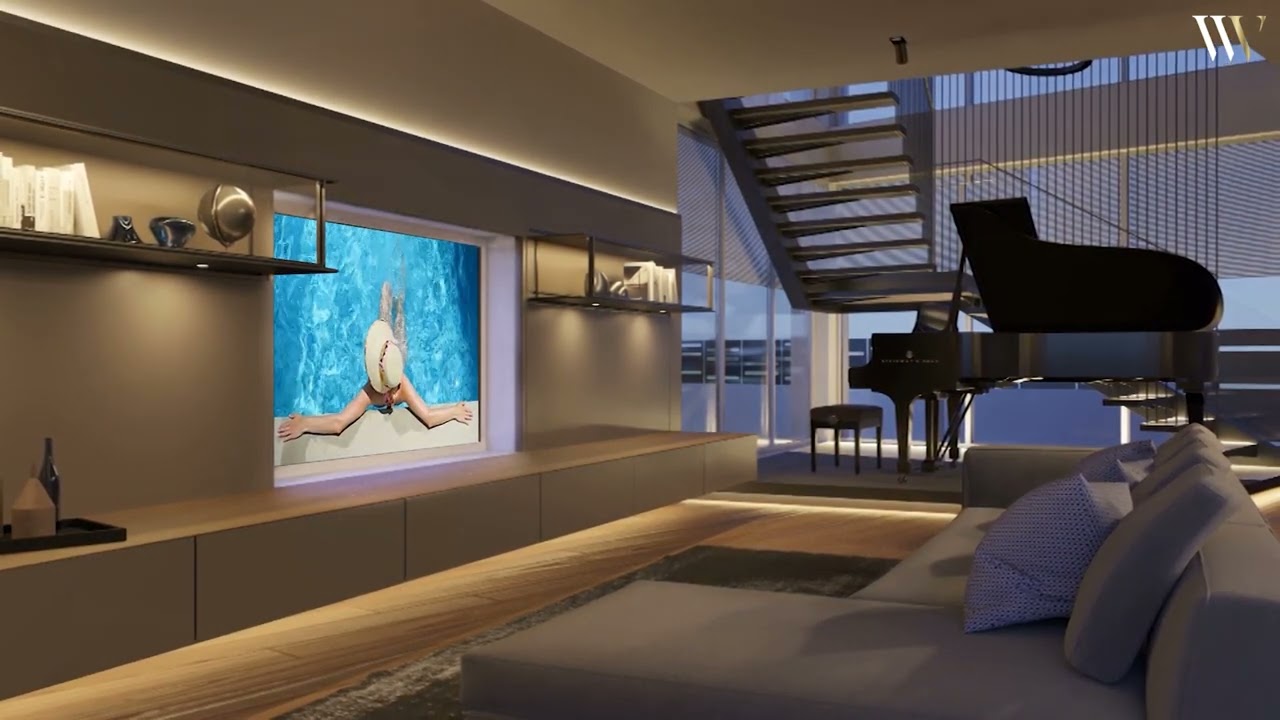
The solution that meets these needs is a window with an integrated TV screen.

[ Photo: Wondervilla living area with TV-window technology ]

At first glance it looks like an ordinary window, but at the touch of a button or a wave of the hand the TV screen appears instantly, thanks to the OLED technology installed inside the glass.

Thanks to this window and to home automation, you can choose the scene you want.

For example, you can set the Relax Scene, which makes the glass clear so you can see the garden outside, turns on classical music and adjusts the lights for reading.

Or, as in this case, the TV Scene, which darkens the glass, switches on the television, turns off the music and dims the lights, so you can watch your favourite film in complete comfort.

When we design a Wondervilla, we also analyse all these aspects, because glass often helps to avoid small, dark rooms.

If you would like to know more about our working method, book a personal video call with no obligation and you can tell me about your specific needs.

If you would like to ask us something straight away, call us or message us on WhatsApp at +39 392 150 0378 and one of our Architects can already give you some initial answers.

CategoriesTechnology

A design wine cellar for your villa

Salvador Dalí said: “True connoisseurs do not drink wine: they taste secrets”.

He was right, because wine is never the same and, if it has been well stored, as you taste it, it reveals all its secrets: the vintage, the winery, the quality of the grapes, the type of ageing and all its most hidden aromas.

Over time, the way the wine cellar is experienced has changed a great deal.

In the past, the traditional cellars found in villas were dark, damp underground rooms, used mainly for storing wine, where you could not stay for more than 10 minutes.

Now, instead, your villa can have a temple to fine wines, suited not only to storage but also to entertaining, with every comfort, where you can welcome family and friends to sip a glass of vintage wine and discover its secrets in complete relaxation.

The cellar should be a place capable of turning wine into emotion, and it becomes one when it is built to meet certain parameters:

  • objective ones, which the bottles require for a pleasant and lengthy stay in the cellar (lighting, temperature, humidity, etc.)
  • subjective ones, which make the cellar beautiful, comfortable and built around you and your fine wines (size, design, type of furnishings, colours, lights, music, etc.).

To design the cellar in your villa as well as possible and make it a space to enjoy, we use these technologies:

  • Cellar climate control. Everything starts with the correct thermal insulation of the space. This can be natural (if the cellar is fully underground) or will need to be artificial, using suitable insulating materials. Finally, the air-conditioning system maintains the ideal microclimate for storing wine, so that you always have the most suitable temperatures for the various types of wine (still or sparkling, white, red or rosé) without putting their storage at risk.
  • LED lighting. It offers several advantages: because you can choose and adjust the intensity, temperature and colour of the light emitted, it lets you highlight and enhance the details, materials and furnishings in the cellar. So you can create a romantic atmosphere and taste your favourite wine with your partner.
  • Music. Have you ever heard of water memory? In 1990 Masaru Emoto carried out a series of experiments observing the physical effect of words, prayers, music and the environment on the crystalline structure of water. The ice crystals formed from water exposed to music and words of love were regular and symmetrical, while those formed from water exposed to aggressive music and words were irregular and amorphous.

Later, the SBQ (Società Internazionale di Semeiotica Biofisica Quantistica, the International Society of Quantum Biophysical Semeiotics) also showed that music does energise water and that water memory-information really exists.

Wine is 85% water molecules, so it is important that it is kept in a positive environment where good music is played, perhaps even when the cellar is closed and the wine is resting. That way, as well as having good wine, you can spend pleasant moments with friends, with your favourite music in the background.

  • Home automation. By controlling the lighting, music and climate, home automation makes your cellar a truly welcoming, well-appointed space.

It lets you create personalised lighting scenes that you can activate from your smartphone before entering the cellar, so as to welcome and impress your guests.

In addition, with sommelier software you can be told which bottle is best for the occasion, so every one of your bottles takes centre stage and at any moment you and your friends can learn about its characteristics.

Personalisation is the key word not only for your villa but also for these cellars made by Winest.it (www.winest.it), which are designed in every detail to be the finest temple for your wine, built to reflect your taste in harmony with the functional and practical criteria needed to store wine correctly.

In the villas we design, the wine cellar is planned together with the rest of the house: insulation, climate control, lighting and home automation are planned before construction begins.

If you would like to know more about our working method, book a personal video call with no obligation and you can tell me about your specific needs.

If you would like to ask us something straight away, call us or message us on WhatsApp at +39 392 150 0378 and one of our Architects can already give you some initial answers.

CategoriesTechnology

Wallcovering: the alternative to the plain white wall

Beyond the plain white wall: a guide to choosing the right wallpaper for you.

Have you ever walked into an old flat with odd, yellowed decorations on the walls that make the room dark and leave it with a stale, musty smell?

Well, what you experienced was an encounter with “wallpaper”, the paper used to cover walls and surfaces that was so fashionable in the 1970s.

But now, fortunately, things have changed.

[ Photo 1: Comparison between a 1970s interior with old wallpaper and a bedroom interior created with wallpaper by Wall&Decò]

In Italy, wallpaper reached its peak in the 1970s, entering every home as a genuine element of interior decoration, far cheaper than hand-painted wall decoration.

In short, the idea was to give a home a refined look by applying decorations to the walls that were much cheaper than those found in frescoed villas.

At that time, rather than floral patterns, it was mainly geometric motifs that were printed on rolls of paper. The paper from these rolls was then pasted onto the walls, one strip next to the other.

The result was that sense of repetition and monotony that overwhelmed you 5 minutes after entering the room and made you want to leave straight away.

When I found myself in rooms like these, I would often start looking for the join between one strip of paper and the next, just to work out where the pattern started and repeated. Once I had found it, the game was over and I wanted to leave.

Now “wallpaper” has evolved into “wallcovering”, a combination of design, technology and photographic quality. It has a strong visual impact and aims to move and inspire those who live in the space.

Do you know the feeling you get from a painting by your favourite artist?

Well, you can have the same feeling sitting comfortably on your sofa, sipping a good cup of tea and looking at your favourite painting applied to the wall in front of you.

Wallcovering gives you a sense of graphic continuity, as if it were a single drawing or the reproduction of a photograph.

In fact, the drawing, painting or photograph can be printed across several strips of paper which, once joined, give the complete image.

With 1970s wallpaper this effect was not possible, because all the strips had the same pattern and, once hung side by side, became repetitive and made the unsightly joins stand out.

So far I have told you about the design and photographic quality of Wallcovering, but there is another very important aspect that sets it apart from old wallpaper: the technology used to make it.

The latest generation of Wallcovering consists of vinyl decorative papers made of two layers: the printable upper side in vinyl, that is, a very thin transparent plastic sheet, and on the back a sheet of non-woven fabric, which in practice is a very thin fabric made of synthetic fibres.

This type of backing also makes them suitable for the most humid rooms, and many of these decorative papers can be hung anywhere: in the living room and the bedroom, but also in the kitchen or bathroom.

This is entirely new for this type of wall covering, which has always been the enemy of damp places.

[ Photo 2: Bathroom covered with “wet system” wallpaper by Wall&Decò]

But let us also look at all its other features.

Wallcovering is non-absorbent.

The vinyl paper I mentioned earlier does not absorb water, even when there is a lot of steam and humidity in the room.

These papers can also be applied in your bathroom and your kitchen.

You can also wash them very easily with soap and water, so they will always look as colourful and bright as new.

Finally, you will no longer see mould or stains in the house, and you will not run the risk of having to replace the paper after a short time because it has yellowed and peeled.

Now you will be wondering:

“But hold on, will I be living in a room that cannot breathe?”

Do not worry: it is no longer like the 1970s, when wallpaper was applied to all four walls of the room. Today the aim is to enhance a single wall with a unique, distinctive design, to give it prominence.

In any case, remember that the latest homes, and all Wondervilla villas, always have mechanical ventilation with heat recovery, which changes the air 24 hours a day and lets you breathe clean air at all times.

Wallcovering is odourless.

The vinyl backing it is made of absorbs neither water nor odours.

One of the reasons you notice a strong musty smell when you walk into a flat with rooms covered in old wallpaper is that the paper in these old coverings absorbs the smell of food and of the people who live in the rooms.

Now, with vinyl papers and the natural, eco-friendly adhesives used to apply them to the walls, this no longer happens.

This means you will not notice unpleasant smells around the house, and you can be sure that every room smells fresh.

Wallcovering is fire-retardant.

Thanks to this property, it resists fire and limits the spread of combustion, so if you apply Wallcovering in rooms such as the kitchen you will always feel safe, even while cooking.

[ Photo 3: Kitchen wall covered with Wall&Decò wallpaper]

Now that you have seen the features that set Wallcovering apart from old wallpaper, if you are an original, creative person with “good taste”, you are no doubt wondering:

“How far can I personalise my home and avoid having all white walls?”

Well, the possibilities are many.

You can create a personalised atmosphere for each room, with different designs everywhere… but be careful not to overdo it.

In fact, Wallcovering offers an endless variety of settings:

to create the right atmosphere in every room, you can choose from a vast range of themes, from the most relaxing and intimate ones suited to bedrooms, in soft, delicate colours, to bolder, more colourful ones for the living area.

There is an endless variety of designs and images, from floral to geometric, from black and white to colour, from figurative to abstract: in short, you can let your imagination run free and enjoy finding your own design, the one that suits you best.

This material allows the highest degree of personalisation and can give your villa that extra touch of distinction it deserves.

[ Photo 4: Living area wall covered with wallpaper by Inkiostro Bianco]

But if you want something unique, if there is a design that is dear to you, if you want a print made from one of your own drawings, or from your child’s for their bedroom, this can be done: this is what we mean by personalised.

[ Photo 6: Living area covered with wallpaper by Glamora ]

Personalised, crafted fully bespoke, designed around you: these are the qualities your villa should have in every respect, whether it is a wall, as we have just seen, or even a floor.

“But would you like to know how far research and innovation have gone?”

It is now possible to create something unique even with a classic material such as a wooden floor.

These designs can be printed and engraved directly onto the parquet in your home, giving it a unique detail that few people can have.

You will have all the advantages of wood, including walking on it barefoot and still feeling its warmth, but with the personalisation that was previously only possible with ceramic tiles.

Wooden flooring can therefore also be transformed and personalised, and if you want the latest innovation and a truly unique floor for your villa, this is the right idea.

[ Photo 7: Detail of a print on wood flooring by Inkiostro Bianco & Listone Giordano]

In the villas we design, the walls to be highlighted are chosen as part of the interior design, together with the lighting and furnishings that accompany them.

If you would like to know more about our working method, book a personal video call with no obligation and you can tell me about your specific needs.

If you would like to ask us something straight away, call us or message us on WhatsApp at +39 392 150 0378 and one of our Architects can already give you some initial answers.

CategoriesTechnology

An office in your villa for business meetings

How to turn a business meeting into a success

If you are an entrepreneur, a self-employed professional or a company manager, part of your work involves planning meetings with your clients and suppliers to close a deal or sign an important contract.

On these occasions, to make an excellent impression, you take care of every last detail: you wear your most elegant suit, buy a bottle of the finest vintage Cognac and put your office in perfect order.

The problem is that your company or your practice is – rightly – a place of work, where the focus is on getting things done and where there may be machinery and a constant coming and going of people busy with production.

Your desk is probably buried under the pile of documents you have to sign every day, and there are no elegant armchairs, because at the office your mind is on work, and you may have chosen to invest in a machine instead.

In a company office, the focus is often more on production than on elegant furnishings.

It is only when you have arranged the meeting with an important client that you realise they might not feel entirely at ease.

At this point you have two options:

  • You take them to your company office anyway, where the phone rings every 2 minutes and your staff put their heads round the door, ignoring your request for confidentiality;
  • You take them to the elegant executive office you have set up in your Wondervilla.

[ Executive office by Giorgetti, photographed at the Salone del Mobile 2018 ]

Today many entrepreneurs and professionals choose to set aside an entire area of their villa for work, very often with an entrance entirely separate from the domestic one.

They are professionals who, like you, need:

  • discretion and complete privacy for the most confidential work, for meetings with extremely important clients or for private meetings with their partners.
  • an elegant and welcoming office that puts the client at ease. An office, in short, that is less formal than the working office at your company.
  • to be hospitable to their clients as well. With an executive office in your villa you can offer your guests lunch or dinner without going out to a public restaurant, where you never know who is sitting at the next table.

Or, quite simply, they want a second office where they can work early in the morning, or outside normal hours at the weekend, without having to travel.

[ Executive office by Giorgetti, photographed at the Salone del Mobile 2018 ]

There are hundreds of articles online explaining how to “carve out” an office corner in your sitting room or bedroom, but I will tell you straight away that you will find nothing of the sort here.

If you want an office at home for important meetings or for working at night, it is essential that it guarantees you complete privacy and confidentiality, if you want to maintain a high level of concentration.

This is to avoid interference with all the other activities of the house, and to prevent your most important client from seeing the cleaner vacuuming the sitting room or changing the sheets in the bedroom.

To keep it entirely separate from the more domestic functions, you could consider a room that works like a small “annexe”, with its own entrance and a private bathroom.

Your elegant home office will also need to live up to expectations, with a refined design consistent with that of the villa, so that the style is harmonious and there are no jarring contrasts.

Your office could have a bar corner with cigars, a small wine cellar to celebrate the close of a deal with a good vintage wine, or a billiard table to release the tension of the meeting together.

Would you like your best clients to feel at ease, and turn your business meeting into a success?

Welcome them into your villa.

In the villas we design, the executive office is planned with its own entrance and facilities, so that work does not intrude on the life of the house.

If you would like to know more about our working method, book a personal video call with no obligation and you can tell me about your specific needs.

If you would like to ask us something straight away, call us or message us on WhatsApp at +39 392 150 0378 and one of our Architects can already give you some initial answers.

CategoriesTechnology

The benefits of a private spa in your villa

Since the earliest civilisations, people have always had a very close relationship with water.

From a sacred element in Greek civilisation, to a symbol of birth and rebirth in some very ancient religions, to a therapeutic function and a very important role in the Egyptians’ pursuit of physical and mental well-being.

In ancient Egypt, for example, members of the wealthiest families would devote themselves to skin-toning rituals, bathing in tubs in which lotus flowers, roses, jasmine or lilies had been left to steep. The skin was then cleansed with essential oils of almond and sesame, and with olive oil.

Washing and taking care of oneself was therefore a pleasure as well as a matter of hygiene.

Today we are seeing renewed attention to ourselves and our own well-being. It is no coincidence that a great many spas have opened, offering different kinds of wellness programmes, and one of the most sought-after holidays is the classic “relaxation break” at one of these centres.

I am sure that you too, if your work keeps you constantly on the move, with a very high level of attention and maximum concentration, go to wellness centres, driven by the need to release the tension.

But are you sure you could not have something better?

I say this simply because many people feel slightly uncomfortable when they use wellness centres open to the public, and experience unpleasant sensations due to:

  • uncertainty about the standard of hygiene in the various areas, where you often come into contact with surfaces with your bare skin;
  • noise and background chatter from guests who are not very mindful of discretion;
  • lack of privacy and intimacy, as you are always exposed to the eyes of strangers;
  • temperatures too high or too low for your needs;
  • scents that do not suit your sense of smell;

In the end, the days that were meant to help you recover your energy and concentration often turn into a source of further stress.

So why not create a spa in your villa?

Having a space in your home entirely dedicated to well-being will allow you to enjoy a well-deserved moment of relaxation at the end of the day, without having to worry about going out again or booking a session at a wellness centre open to the public.

Indeed, the possibilities offered by technology make it possible to revive those ancient rituals, add to them and bring into your home features such as:

  • Whirlpool Bath, which will help you release muscle tension through the massage of the water bubbles;
  • Sauna, which will give you healthier skin, because you will have eliminated toxins through perspiration;
  • Steam Room, which will clear your airways through the natural action of the steam;
  • Experience Shower, with chromotherapy and water scented with essences;
  • Kneipp Path, with which you will improve your blood circulation by immersing your legs up to the calf, alternately in hot and cold water
  • Salt Cave or Salt Walls, with which you will recreate at home the benefits of breathing salty, iodine-rich air;
  • Relaxation Room with chaise longue, to enjoy a moment of rest with scents and relaxing music.

You can have all of this with a villa we craft fully bespoke for you, by asking for spaces designed specifically for your relaxation and tailored to your needs, like the spa bathroom you see below, designed by Wondervilla.

In the villas we design, the spa is conceived together with the rest of the house: home systems, ventilation and materials are planned before construction begins, around the habits of those who will live there.

If you would like to know more about our working method, book a personal video call with no obligation and you can tell me about your specific needs.

If you would like to ask us something straight away, call us or message us on WhatsApp at +39 392 150 0378 and one of our Architects can already give you some initial answers.

CategoriesTechnology

Wondervilla – One Team BIM Conference – Assimpredil ANCE Milano

On 15 May I had the honour of presenting Wondervilla as a case study at a conference on BIM and its applications in contemporary architecture and construction.


The event, organised by One Team and Assimpredil-ANCE, took place at the ANCE offices in Milano, before an audience of 200 professionals and business owners.

During the presentation I explained how Wondervilla began and how I transformed my business from a general building firm into a company specialising in the design and construction of fully bespoke contemporary villas with an earthquake-resistant steel structure.

It all began with the need to protect Clients from the design and construction errors that inevitably drive up both build times and costs.

Thanks to BIM technology and rigorous procedures, the Wondervilla Method overcomes these problems and can build “turnkey” villas anywhere in Italy. We also have our sights set on projects abroad.

I discovered that of Italy’s 500,000 construction companies, only 50 use BIM, and Wondervilla is one of them.

This event, and the many people I met there, gave me great satisfaction and confirmed that the choices made over the last 3 years of work were the right ones.


In the villas we design, BIM supports the entire process, from the design to the build: it reduces errors and allows us to set out time and costs in the contract.

If you would like to know more about our working method, book a personal video call with no obligation and you can tell me about your specific needs.

If you would like to ask us something straight away, call us or message us on WhatsApp at +39 392 150 0378 and one of our Architects can already give you some initial answers.