

If you have always thought of glass as a fragile, delicate, inflexible material, used only for windows or balustrades, read on, because today I will show you some of its qualities that will make you see it differently.
In fact, glass is a surprising material that can completely change the space in your villa, making rooms larger, more harmonious and more versatile.
Did you know that you can decide how transparent the glass should be, depending on how you want to live in and furnish the rooms of your home?

Put simply, there are 3 degrees of transparency in glass: clear, frosted and lacquered.
Clear glass has the highest degree of transparency: it lets light pass freely from one room to another and lets you see everything on the other side of the glass.
Frosted glass, on the other hand, has a reduced degree of transparency and a uniform satin effect. It still lets light through, but does not let you see everything as sharply as clear glass does.
Lacquered glass has no transparency; it can be matt or gloss, it does not let light through and so does not let you see beyond it, or hardly at all. It looks just like solid panels or wardrobe doors.
When should you use one type of glass rather than another?
Each type of glass suits a different use or the design you want to give the room.
If you would like a separation between the dining area and the TV area without dividing them sharply, so as to make the space look larger, you can use clear glass, clean and essential.

As you can see in this photo, the space looks much larger, more welcoming and versatile, and it is divided without building actual masonry walls that would make it closed and dark.
Likewise, if you divided every room in your home according to its function, you would end up living in a house with narrow, stifling spaces that do not suit the way you live.
Using clear glass partitions indoors serves precisely to avoid real walls where they are not needed.
If, instead, you need to create a veiled effect, half seen and half hidden, you can use frosted glass, elegant and practical.

For example, you might want to close off the walk-in wardrobe next to your bedroom without showing all your clothes, leaving the interior only partly visible. To do this, you cannot use clear doors: you will need frosted glass ones.
The same reasoning applies to the private en-suite bathroom/shower: to avoid a sharp separation between these two spaces, you can use glass partitions that are more or less frosted, depending on how much privacy you want. This way the two spaces will feel much larger and brighter.
Likewise, if you want a kitchen where you are free to cook in privacy while your guests are in the living room, you can create a separation with frosted glass doors that you can close or open as you please, letting light through while giving you the discretion you are looking for.
Or perhaps you would like a small private study in your home and want privacy without a solid wall?
In this case you can use a sliding or hinged panel in matt lacquered glass, which will let you divide the space easily and create the privacy you are looking for.

The main advantage of these lacquered glass panels is that they create a flexible space that is easy to change.
In fact, if during a party you want to give your guests more room to move or show them your design study, you only need to slide the doors open and the living room becomes one with the study.
Or, if your needs change and you no longer need the study, you can transform it by joining it to the living room, without the trouble of demolishing real walls and all the inconvenience of dust and builders around the house.
I began this article by saying I would change your mind about glass, and to be sure of succeeding I will now tell you about glass that can be clear, frosted or opaque as you wish.
This is possible thanks to a liquid crystal (LCD) film inserted between two panes of glass. Using a manual or home automation control, the orientation of the LCD crystals can be changed, altering the amount of light that passes through the glass, from completely clear to opaque. Glazing that can take on every degree of transparency allows you to create all the configurations of atmosphere and privacy you want in your villa.
Finally, in addition to the features I have described above, I want to tell you how a window in the living room can change the way you live in your home.
Do you ever have moments when, coming home after working all day, all you want is to lie on the sofa and not get up again, enjoy a good film and relax with your family?
Or other moments when you would like to lie back on the sofa with a beautiful view of the greenery of your garden?
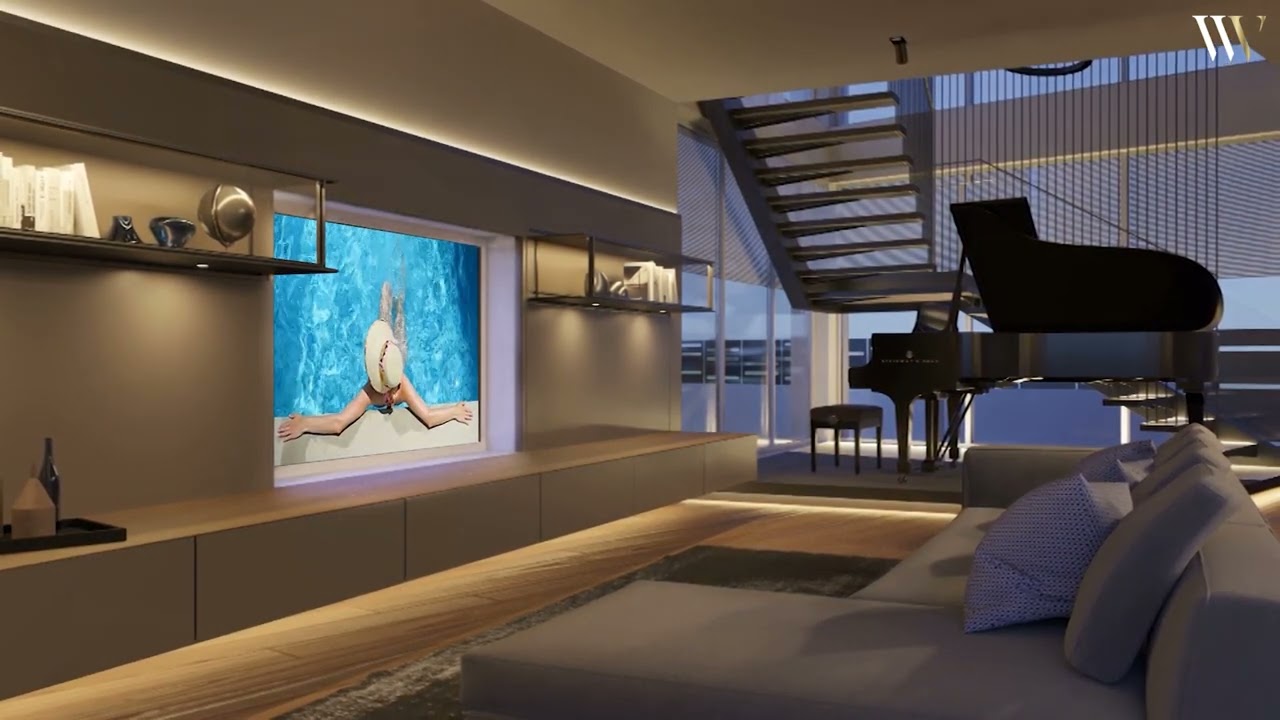
The solution that meets these needs is a window with an integrated TV screen.

At first glance it looks like an ordinary window, but at the touch of a button or a wave of the hand the TV screen appears instantly, thanks to the OLED technology installed inside the glass.
Thanks to this window and to home automation, you can choose the scene you want.
For example, you can set the Relax Scene, which makes the glass clear so you can see the garden outside, turns on classical music and adjusts the lights for reading.
Or, as in this case, the TV Scene, which darkens the glass, switches on the television, turns off the music and dims the lights, so you can watch your favourite film in complete comfort.
When we design a Wondervilla, we also analyse all these aspects, because glass often helps to avoid small, dark rooms.
If you would like to know more about our working method, book a personal video call with no obligation and you can tell me about your specific needs.
If you would like to ask us something straight away, call us or message us on WhatsApp at +39 392 150 0378 and one of our Architects can already give you some initial answers.